
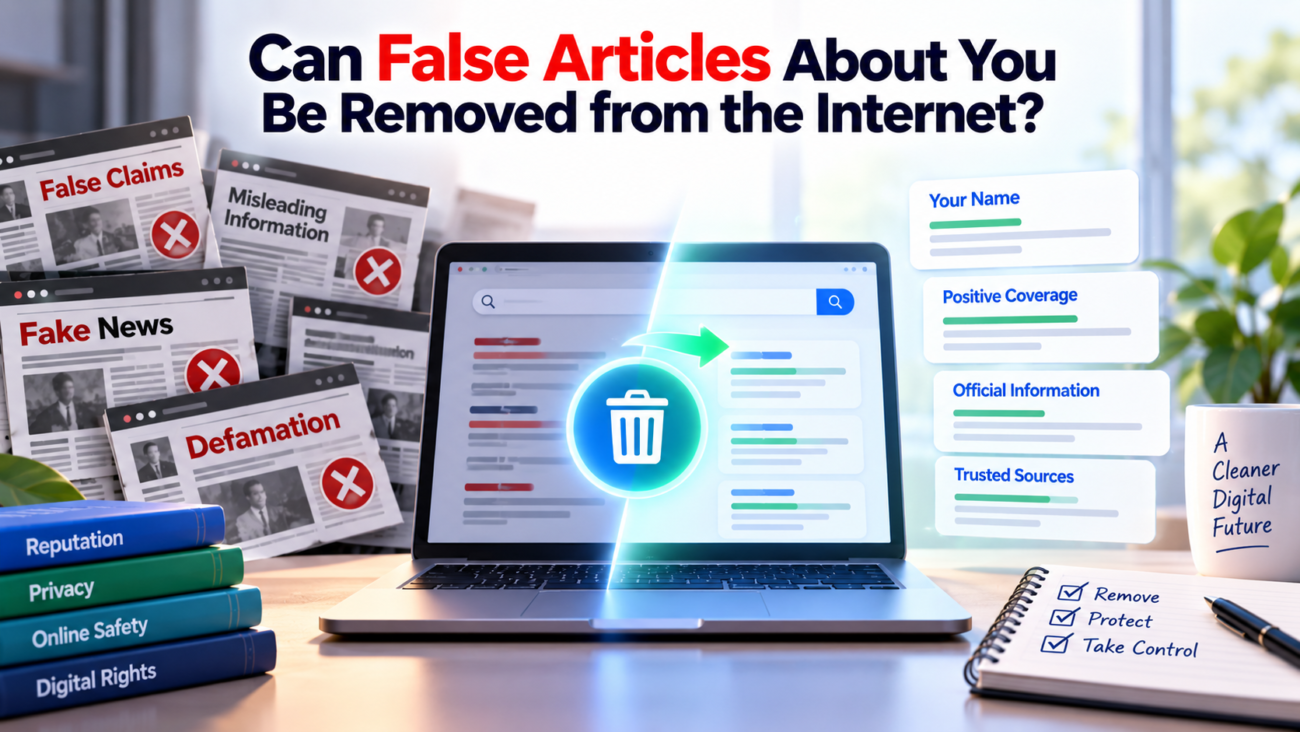
Finding a false article about yourself online can be upsetting and damaging. Whether it contains inaccurate information, misleading claims, or completely fabricated allegations, false online content can affect your personal reputation, career opportunities, business relationships, and emotional well-being. Since search engines make information easy to discover, even a single false article can continue attracting attention long after it is published.
The good news is that false articles can sometimes be removed or corrected, but the process depends on where the article is published, whether the information is genuinely false, and the laws that apply in your jurisdiction. While there is no universal solution that guarantees removal, there are several legitimate and ethical ways to address false online content.
This guide explains your options for dealing with false articles and protecting your online reputation.
What Is a False Article?
A false article contains information that is inaccurate, misleading, or presented as fact when it is not true.
Examples include:
- False accusations
- Incorrect personal information
- Misidentified individuals
- Fabricated events
- Fake interviews
- Misleading headlines
- False business claims
- Incorrect legal information
- Edited or manipulated content
Not every negative article is false. Honest opinions and accurate reporting are generally treated differently from factual inaccuracies.
Can False Articles Be Removed?
Sometimes they can.
The outcome depends on several factors, including:
- Who published the article
- Whether the information is actually false
- Whether the publisher is willing to correct it
- Whether the article violates applicable laws
- Whether the content violates the platform’s policies
Each situation requires an individual assessment.
Step 1: Verify the Information
Before requesting removal, carefully review the article.
Ask yourself:
- Which statements are false?
- Can the claims be verified?
- Are there factual errors?
- Is important context missing?
- Is the article confusing you with someone else?
Gather evidence that supports your position before contacting anyone.
Step 2: Contact the Publisher
Many websites allow readers to request corrections.
Your request should include:
- The article URL
- A clear explanation of the inaccurate information
- Supporting documents
- The corrections you are requesting
Professional communication often produces better results than emotional responses.
Step 3: Request a Correction
Many publishers prefer correcting factual errors rather than deleting an article entirely.
Possible outcomes include:
- Corrected information
- Updated article
- Editor’s note
- Clarification
- Published correction
- Additional context
An updated article may significantly reduce reputational harm.
Step 4: Understand Google’s Role
Google generally does not create online articles.
Instead, it indexes webpages that already exist on the internet.
If the original article remains online, Google will usually continue displaying it unless it qualifies for removal under Google’s published policies or applicable legal requirements.
Removing content from the original website is often the most effective solution.
Step 5: Explore Legal Options
If the article contains defamatory or unlawful content, legal remedies may be available depending on your jurisdiction.
Situations that may warrant legal advice include:
- Defamation
- False allegations
- Identity theft
- Privacy violations
- Copyright infringement
- Fraudulent impersonation
A qualified attorney can advise whether legal action is appropriate for your circumstances.
Step 6: Build Positive Online Content
If removal is not possible, strengthening your online presence can help create a more balanced digital reputation.
Examples include:
- Personal website
- Professional biography
- Industry articles
- Press releases
- Educational content
- Conference presentations
- Business profiles
- Community involvement
Publishing valuable content consistently helps demonstrate credibility.
Monitor Your Online Reputation
Regular monitoring allows you to identify false information quickly.
Review:
- Google Search
- Google News
- Image search
- Social media
- Business directories
- Review platforms
Early detection often makes reputation management easier.
What Should You Avoid?
When dealing with false articles, avoid actions that could make the situation worse.
Do not:
- Threaten publishers without legal grounds.
- Publish false information in response.
- Buy fake reviews.
- Use spam techniques.
- Harass journalists.
- Spread the article further by repeatedly sharing it.
Professional communication is usually the most effective approach.
Long-Term Reputation Management
Protecting your reputation requires ongoing attention.
Good practices include:
- Publishing helpful content regularly.
- Maintaining updated professional profiles.
- Monitoring search results.
- Responding professionally to legitimate concerns.
- Correcting misinformation promptly.
- Building relationships with trusted publications.
A strong online presence makes isolated false information less influential over time.
Common Misconceptions
Many people believe certain myths about removing online content.
Some common misconceptions include:
- Google owns every webpage in search results.
- All negative articles can be deleted.
- Legal action always results in removal.
- Publishers must delete articles upon request.
- Reputation management produces immediate results.
Understanding the limitations helps set realistic expectations.
When Professional Help May Be Appropriate
Professional assistance may be beneficial if:
- Multiple false articles appear online.
- Your business reputation is affected.
- Identity theft is involved.
- The content spreads across multiple websites.
- You receive media attention based on false claims.
- Legal issues become complex.
Reputation management professionals and qualified legal advisors can help evaluate the most appropriate strategy.
Final Thoughts
False articles can significantly affect your personal and professional reputation, but they are not always permanent. The best approach is to document the inaccuracies, contact the publisher with clear evidence, request corrections where appropriate, and explore legal remedies if the content is defamatory or otherwise unlawful. If removal is not possible, building a strong online presence through accurate and authoritative content can help provide a more balanced representation of who you are.
Managing your online reputation is an ongoing process rather than a one-time task. By monitoring search results regularly, responding professionally to inaccuracies, and maintaining trustworthy digital profiles, you can reduce the long-term impact of false information and strengthen your credibility online.
Frequently Asked Questions (FAQs)
1. Can false articles be removed from the internet?
Yes, in some cases. Removal depends on where the article is published, whether the information is genuinely false, whether the publisher agrees to remove or correct it, and whether legal or platform policies apply.
2. Can Google remove false articles?
Google generally does not remove articles simply because they are disputed. However, certain content may qualify for removal under Google’s published policies or applicable legal requirements.
3. Should I contact the publisher first?
Yes. Contacting the publisher and requesting a correction or removal with supporting evidence is often the most effective first step.
4. What if the article contains factual errors?
Publishers may be willing to issue corrections, clarifications, or editor’s notes when presented with reliable evidence that information is inaccurate.
5. Are false articles considered defamation?
Not necessarily. Whether false statements are legally defamatory depends on the applicable laws and the specific facts of the case. A qualified attorney can advise you on your legal rights.
6. Can legal action remove false content?
In some situations, legal action may result in corrections, removals, or other remedies, particularly if the content is defamatory, violates privacy rights, or breaches other applicable laws.
7. Can reputation management help?
Yes. Reputation management focuses on strengthening your online presence through valuable content, accurate information, and ongoing monitoring, helping to improve the overall balance of search results over time.
8. Should I respond publicly to a false article?
It depends on the circumstances. A professional, factual response may be appropriate in some cases, while other situations are better handled privately or with legal advice.
9. How long can false articles remain online?
They may remain online indefinitely unless the publisher removes or updates them, a legal remedy applies, or the website itself is taken offline.
10. What is the best way to protect yourself from false online information?
Maintain an active and professional online presence, monitor your search results regularly, address inaccuracies promptly, protect your personal information, publish authoritative content, and seek professional legal or reputation management advice when necessary.
